From Agency to Product: Turning Services into SaaS on Purpose
The strongest agency-to-SaaS moves start with repeated workflow pain, recurring customer questions, and data the team already earned the hard way. Productization works when that pain becomes a deliberate thesis instead of a side-project graveyard.
Agency
7 min
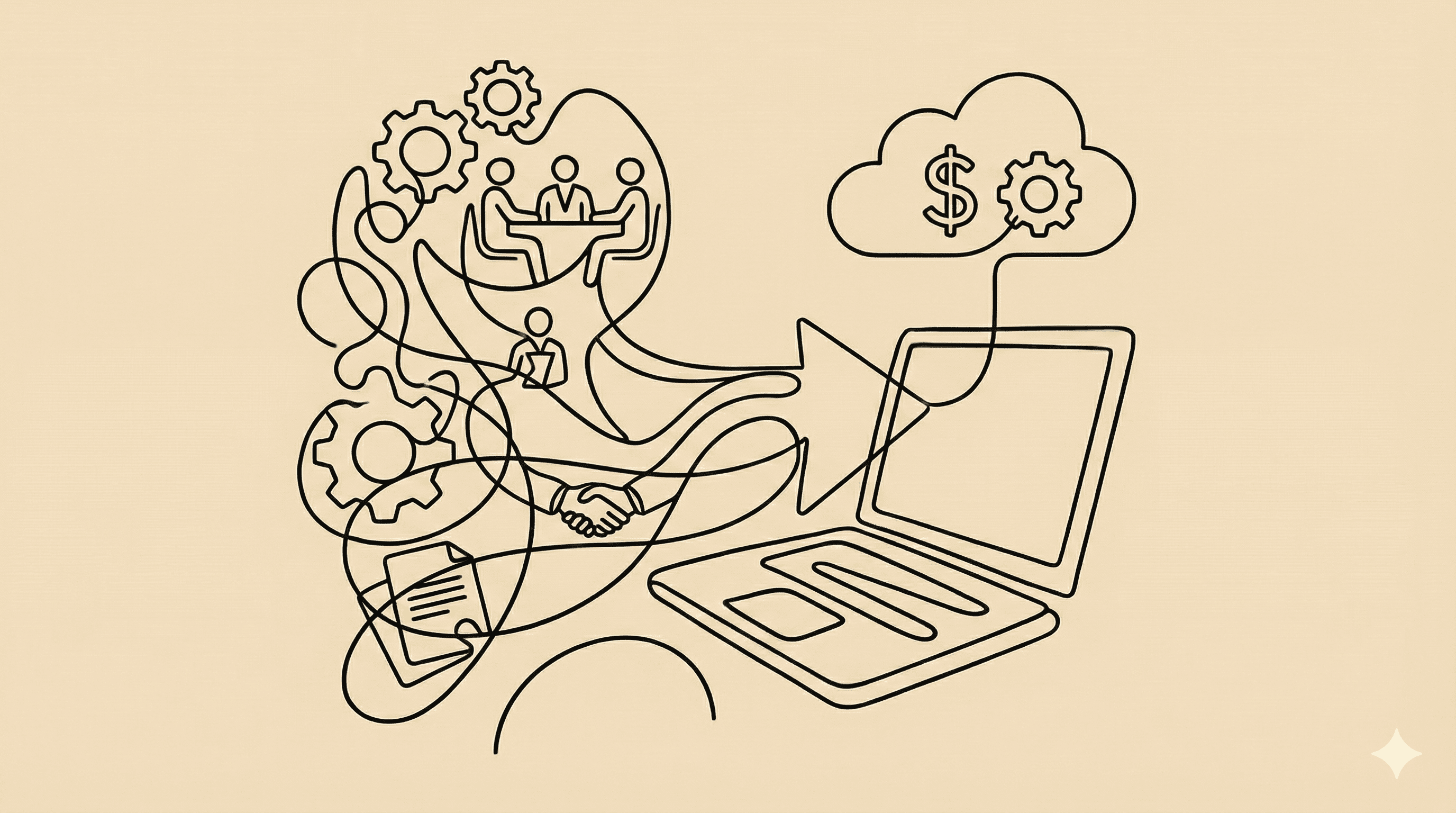
The short version: the best agency-to-SaaS products rarely begin as brainstorms. They usually begin as repeated operational pain inside a service business, then earn the right to become software once the founder can name the workflow, the data, the exception queue, and the buyer value clearly.
That is why I still think agencies are underrated SaaS incubators. They sit close to messy customer reality, see the same failure modes repeatedly, and learn which reports, annotations, and workarounds actually change an outcome. A founder who pays attention to that layer starts product discovery with receipts instead of guesses.
I want this page to connect the Agency to SaaS hub to real cases like Folderly, to The Agency-to-SaaS Bridge Is Data, Not Code, to Service Reports Should Become Product Specs, and to Agency to SaaS Exception Queue. Those are all versions of the same operating lesson.
Why services are such strong product laboratories
A service business touches many similar customers under real stakes. That gives it three advantages a pure greenfield product team often lacks:
Direct contact with urgent buyer problems.
Repeated exposure to the same workflow and the same friction.
Observable ROI when the workflow gets better.
That is why I treat services as distribution and discovery, not as something a founder should rush to escape for status reasons.
The signal that the service should become a product
The pattern I watch for is simple: a workflow repeats, people complain about it constantly, solving it creates visible value, and the solution depends on data or expertise that is not trivial to copy.
When all four show up, I stop and ask whether we are accidentally sitting on a product. That is the idea behind The Best Agency-to-SaaS Clue Is the Exception Queue. The exception queue is where the service business reveals what the product would have to understand, not just what the marketing copy should promise.
Internal tool, packaged service, external product
I still like a staged path because it forces the product to earn its way out of the delivery org.
Internal tool. Solve the team pain first.
Packaged service. Wrap the tool in a priced outcome.
External product. Add self-serve UX, onboarding, and a standalone buying path.
The biggest mistake is trying to jump directly to step three. When founders do that, they often ship software before they have extracted the workflow that made the service valuable in the first place.
This is why Service Reports Should Become Product Specs matters so much here. If your team already writes the pain, the benchmark, the explanation, and the next action every week, those reports are usually the raw material for the product spec.
Keep the data and the exceptions, not just the idea
A lot of agency-to-SaaS efforts fail because the founder extracts a vague idea and leaves the actual operating data behind. I want to know which inputs matter, which outputs change behavior, which edge cases force human review, and which metrics prove the product is better than the service workaround.
Product Pages Should Carry Original Data, Not Better Adjectives explains how the proof should show up commercially.
Service Annotations Should Become Training Data explains what to do with the human judgment layer.
The Agency-to-SaaS Bridge Is Data, Not Code explains why the system usually becomes real before the software brand does.
When those elements are clear, the wedge gets sharper. When they are vague, the team mostly builds a polished wrapper around guesswork.
Ownership matters as much as the opportunity
Productization inside a service company creates internal tension unless one person clearly owns the product. My rules stay simple: be explicit that the product augments services before it replaces them, create separate P&Ls once the economics justify it, and give one person permission to protect the roadmap from endless custom work.
Services are your distribution. Product is your leverage. Do not turn them into enemies.
Where AI helps the transition
AI makes it easier to document workflows, annotate exceptions, and prototype decision support around messy service operations. It does not remove the need for product discipline. If the workflow is still changing weekly, a page like Dynamic Workflows is a useful reminder that the system should mirror the work before the team pretends it has become stable software.
And if the repeatable workflow is not clear enough to write down, AI Operators Need SOPs, Not Prompts still applies. You cannot automate or productize a foggy process just because the tooling got cheaper.
The founder checklist
Is the workflow repeated often enough across clients to deserve a product?
Can we point to the exception queue, the report layer, and the decision logic?
Would at least 5 to 10 current clients pay for this separately?
Do we have one owner who wakes up responsible for product success?
Can we fund a real iteration cycle instead of a side-project sprint?
The strongest agency-to-SaaS moves do not start with software ambition. They start with repeated pain, measurable value, and distribution the service business already earned.
