Distribution‑First Products: How I Think About Building for Acquisition
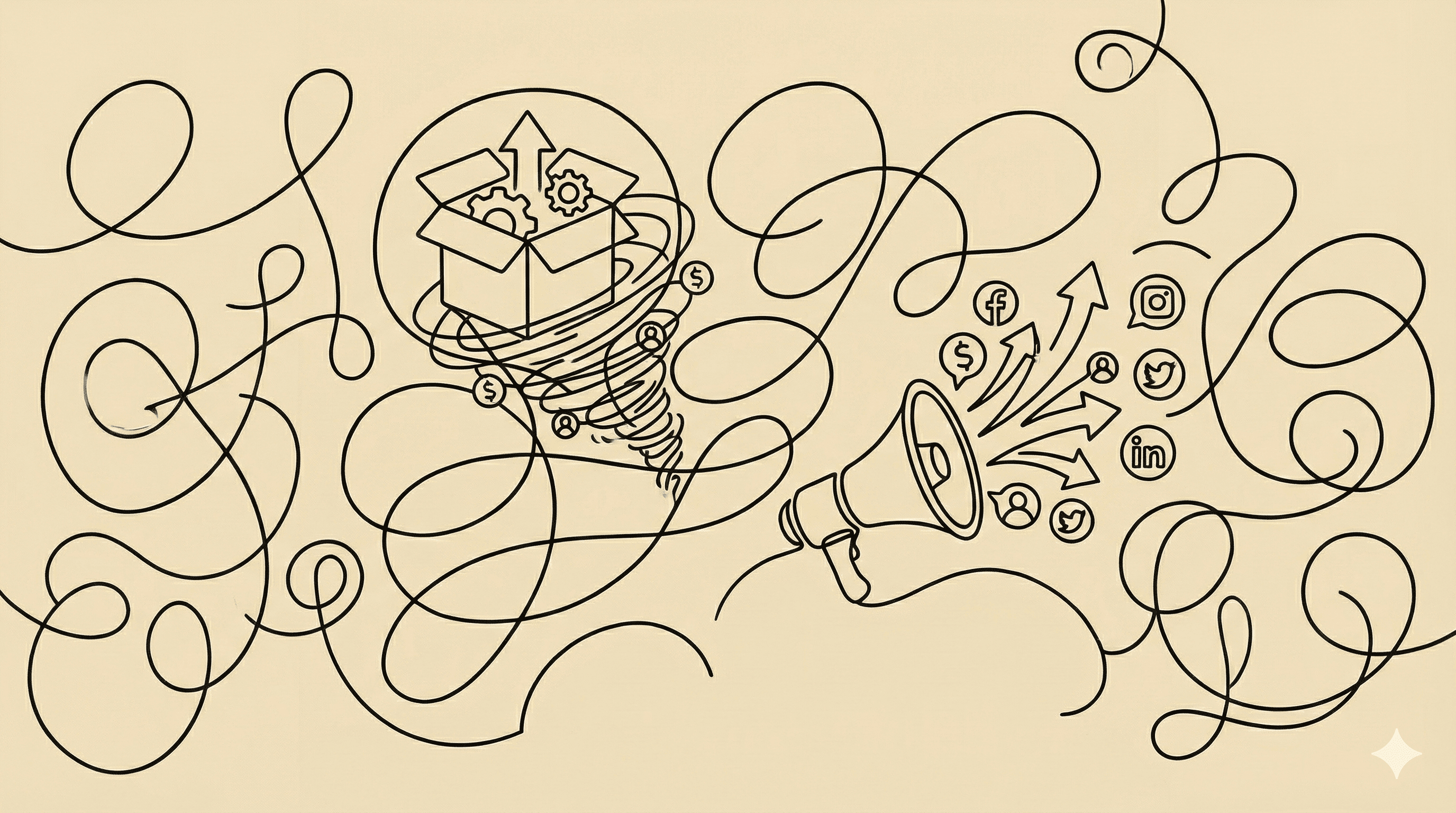
Most products are built and then marketing is asked to ‘go find users.’ I prefer the opposite: start with a distribution thesis, then build a product that naturally spreads through that channel.
Product
5 min
Distribution‑First Products: How I Think About Building for Acquisition
Most products are built and then marketing is asked to “go find users.” I prefer the opposite: start with a distribution thesis, then build a product that naturally spreads through that channel.
At Belkins, Folderly, and now AI‑Operator, I’ve made one rule for myself: never ship a product without a distribution thesis. Not a vague “we’ll do content and outbound,” but a specific answer to: “Why will this product be easy to spread through the channels we already know how to use?” Building for distribution from day one is the only unfair advantage I trust.
1. The usual mistake: product first, distribution later
The traditional sequence looks like:
Build product
Hope it solves a real problem
Ask marketing and sales to “go get customers”
Realize your channels don’t match your audience
I’d rather flip it:
Choose a distribution channel you can win
Design the product so that channel is natural
Ship only what unlocks that channel faster
Let distribution guide your roadmap
This isn’t “growth hacking.” It’s basic survival.
2. The 3 distribution theses I default to
For B2B, my brain usually goes to three primary theses:
Outbound‑native products
Products that are easy to explain and sell via cold outreach.Product‑led products
Tools that spread through usage, invites, or embedded widgets.Partner‑led products
Products that make someone else look good to their clients or audience.
For each new idea, I force myself to pick one primary and a secondary. If I can’t, I’m not allowed to build.
3. Outbound‑native products
Outbound‑native products have:
A clear ICP
An obvious, painful problem
A simple promise that fits in 1–2 sentences
Example pattern:
“We help [very specific role] avoid [very specific pain] by doing [simple, believable thing].”
If I can’t write that sentence, I know Belkins‑style outbound will struggle, no matter how clever we are.
So on the product side, I ask:
Can we narrow the ICP even further?
Can we make the promise more binary?
Can we tighten the outcome so it’s obvious?
The sharper the promise, the easier the outbound.
4. Product‑led products
Product‑led distribution means:
The product creates artifacts (reports, links, widgets) that others see
Users invite other users as part of their workflow
There’s a natural “show, don’t tell” loop
When I think about this for a new product, I ask:
Where does this product naturally touch someone else?
Can that touchpoint carry our logo, link, or brand?
Can we make it valuable enough that users want to share it?
If the product has zero natural surface area, you’re forcing marketing to work twice as hard.
5. Partner‑led products
Partner‑led products win when:
There is a clear ecosystem (agencies, consultants, resellers)
Using your product makes the partner look smart / more profitable
You can align incentives via rev share, co‑selling, or co‑branding
So the product needs:
Clear “partner features” (multi‑tenant, white‑label, reporting)
Simple packaging partners can resell without 10 calls
Reliable, boring performance (partners hate surprises)
If you want a partner engine, build for partners explicitly. They’re not an afterthought.
6. My “distribution‑first” product checklist
Before building, I run through:
Can I explain the product in one sentence tailored to a specific channel?
Do I know exactly who I’d email / call / DM on day one?
Is there any artifact in the product that can spread on its own?
Does this make anyone (partners, agencies, influencers) look good?
Do we already have strength in this channel as a team?
If most answers are “no,” the idea might still be good—but it’s not good for us right now.
7. The meta‑point: build what you can distribute
There are infinite good product ideas.
There are very few product ideas:
You can build well
You can distribute efficiently
You can support with your current team and skills
I don’t want to play the game on “hard mode” just to look innovative.
So I keep coming back to the same question:
“Given our strengths, what products are we uniquely positioned to distribute better than anyone else?”
That question is far more important than whatever is trending on Tech Twitter this week.
Connected reading
Continue with Product Education Is Part of Distribution, Not Support, B2B Content Distribution Loop: 30 Days From One Asset, and The Distribution Advantage of an Agency-Built SaaS, then use the Agency to SaaS hub to connect channel choice to productization.
