Agentic SDR Stack: What AI Will Really Eat in Outbound
AI doesn’t replace SDRs—it replaces glue. SDRs are not your workflow engine. They are your judgment engine.
Sales
5 min
Agentic SDR Stack: What AI Will Really Eat in Outbound
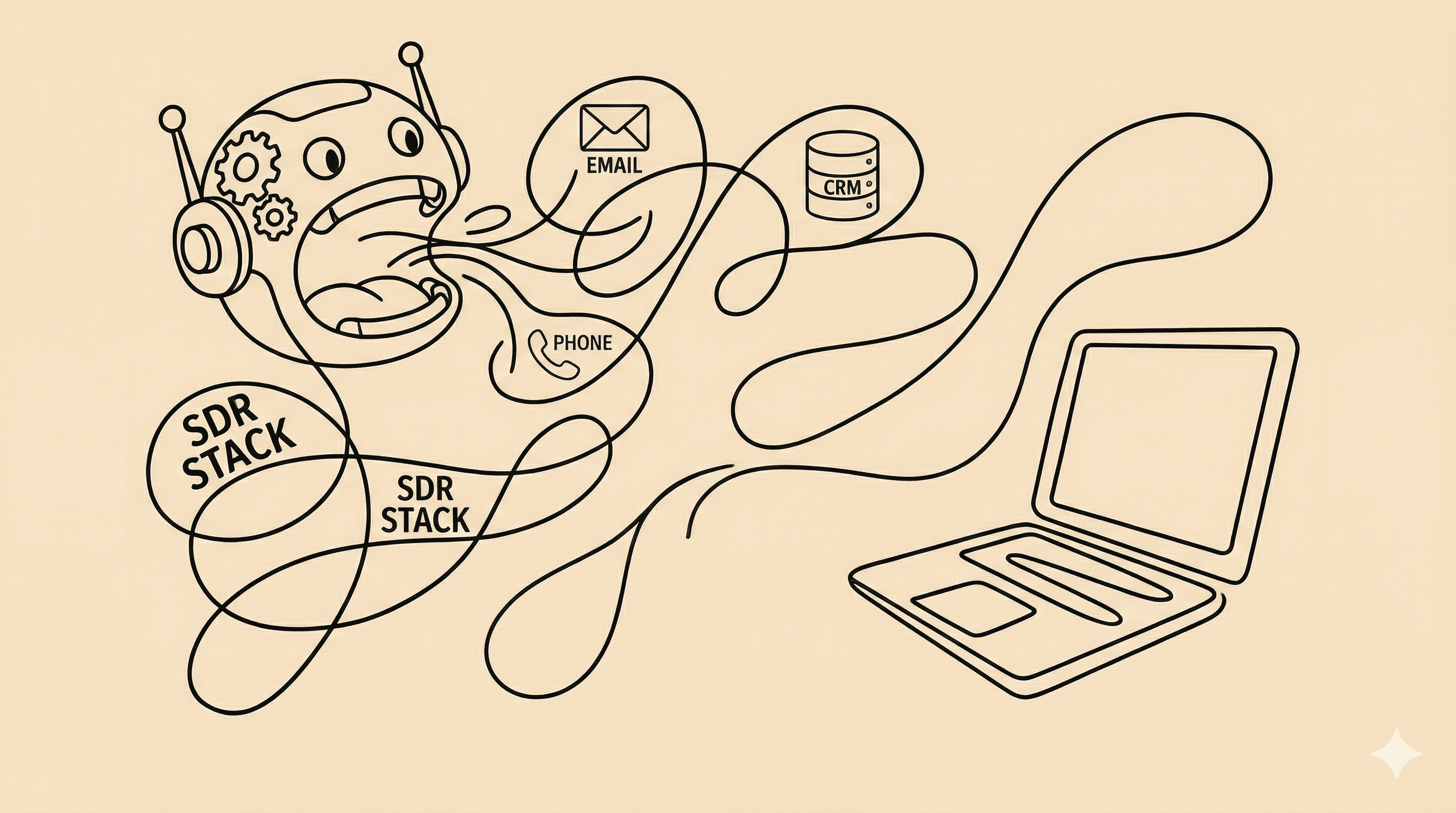
AI should remove mechanical, context-light workflow glue rather than human judgment. Here’s how I think about an agentic SDR stack and where people still matter most.
1. What an “agentic SDR stack” actually means
When I say “agentic,” I don’t mean a chatbot that writes emails.
I mean:
A set of AI agents that can observe the SDR workflow, propose next steps, and execute routine actions within human-approved rules, with uncertain or out-of-scope cases held for review.
Practically, that breaks down into:
Research agents
Persona + messaging agents
Sequence orchestration agents
Post‑reply routing agents
Humans sit on top as editors, closers, and strategists, not as manual task machines.
2. The SDR job, decomposed
If you break the SDR role into tasks, you get something like:
List building
Account and contact research
Message drafting
Data entry and CRM hygiene
Follow‑up scheduling
Reply classification and routing
Actual conversations (email, LinkedIn, calls)
Qualification and discovery
I would automate the repeatable parts of the first six tasks, not declare them judgment-free. People still decide which sources to trust, which ICP and offer to pursue, and whether a message is appropriate. Conversations, qualification, and exceptions stay human-led. The workflow glue is the repeatable execution inside those decisions.
Which means: AI doesn’t replace SDRs—it replaces glue.
3. The “4‑agent” outbound loop
Here’s how I’d design an agentic SDR loop:
Research Agent
Takes a list of domains
Pulls basic firmographics, recent news, hiring, tech stack
Outputs a 5–10 bullet brief per account
Persona Agent
Maps contacts at that account
Chooses the right persona (Head of Sales, RevOps, Founder)
Adapts messaging angle based on role
Sequencer Agent
Schedules human-approved messages within agreed channel, timing, frequency, and suppression rules; holds exceptions for review
Inserts personal snippets from the brief
Ensures we don’t over‑touch accounts
Reply Router Agent
Classifies replies (positive, objection, referral, spam, OOO)
Routes good ones to humans with context
Classifies routine “not now / send info” cases and drafts the next response for human approval; does not treat either as permission for unrestricted follow-up
I want humans to set the rules before the loop runs, approve customer-facing messages, and handle anything uncertain, high-value, or politically sensitive. If the agent cannot establish fit or a permitted next action, it should stop and ask rather than turn a guess into a send.
4. Where humans are non‑negotiable
Things I would not automate away:
Live calls and discovery
Pricing and commercial negotiation
Navigating internal politics at big accounts
Strategic objections and competitive battles
Choosing new ICPs, experiments, and offers
AI is terrible at understanding stakes. Humans are. That’s why the highest‑leverage interactions should stay human.
5. What changes for hiring and comp
In an agentic SDR world:
You need fewer SDRs, but better ones
You care more about writing, thinking, and curiosity than raw activity volume
SDRs become more like junior AEs or mini‑strategists
Comp can follow:
Less emphasis on activity KPIs
More on qualified opportunities created
Even shared variable with AEs on closed revenue
The AI stack does the grunt work. The humans do the asymmetric work.
6. A simple roadmap for teams today
If you run outbound today and want to move in this direction:
Phase 1: Automate research + data entry
Phase 2: Layer in AI‑assisted messaging (but keep human review)
Phase 3: Automate reply classification + routing
Phase 4: Reduce headcount on low‑value tasks and re‑invest in training SDRs as mini‑AEs
You don’t have to jump straight to “full agentic stack.” Just stop making humans copy‑paste data.
7. The mindset shift
The biggest shift is this:
SDRs are not your workflow engine. They are your judgment engine.
Once you accept that, it becomes obvious what AI should do instead.
Connected reading
Use the AI Agents for Operators hub as the operating map, pair it with Founder-Led Outbound, define the role with What Is an AI SDR? An Operator Definition, then gate rollout with the 30-Day AI Agent Pilot Plan and AI Agent Tool Permission Matrix.
